
FERONIX RUST PROTECTION GUIDE
Coastal Corrosion Protection for Steel & Metal | Anti-Rust Solutions
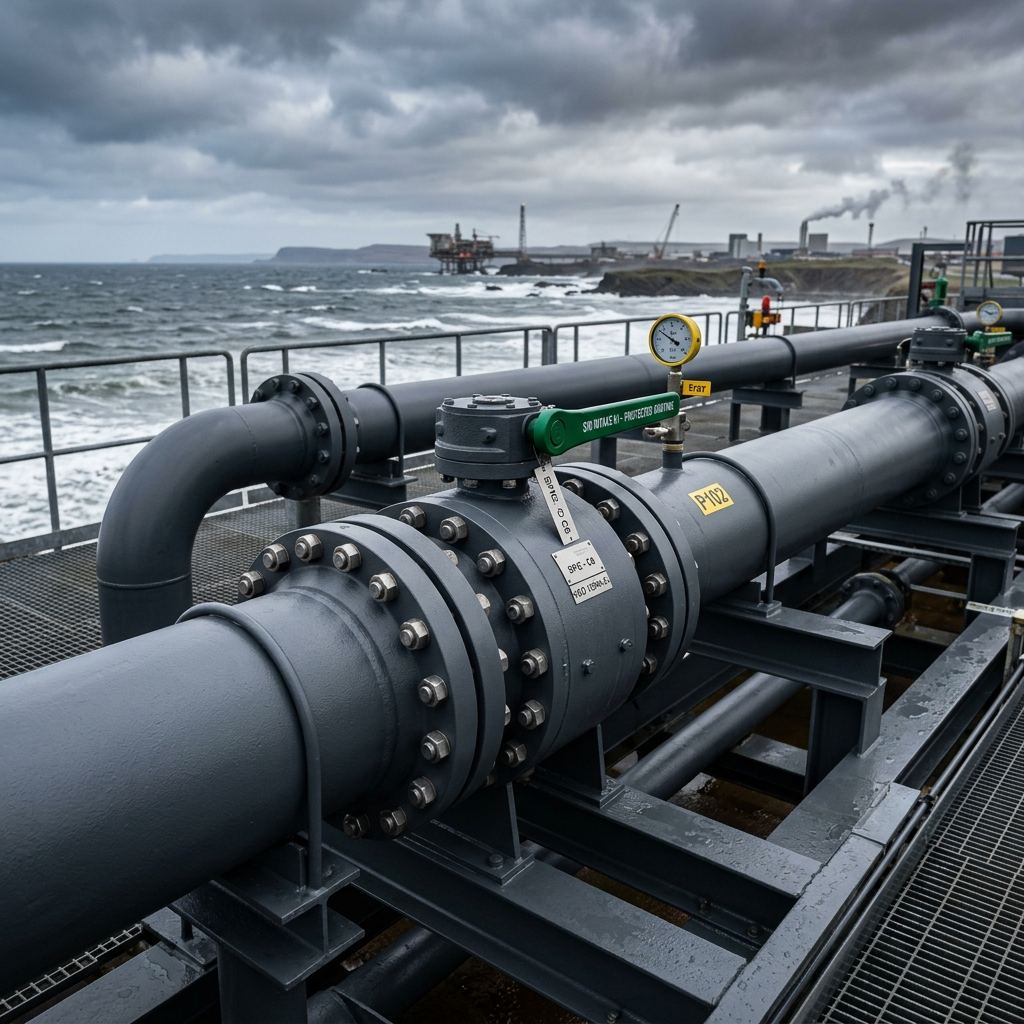
Why Does Metal Rust Faster Near the Sea?
Steel is strong.
But in coastal environments, it faces a particularly aggressive combination of:
MOISTURE + HUMIDITY + SALTS + OXYGEN
This combination can significantly increase the risk of corrosion on exposed steel and iron.
Coastal corrosion can affect:
- Steel structures
- Gates
- Railings
- Fencing
- Industrial equipment
- Machinery
- Fabricated steel
- Outdoor furniture
- Storage structures
- Infrastructure
And the closer the metal is to a marine environment, the more important surface preparation, coating selection and maintenance become.
What Is Coastal Corrosion?
Coastal corrosion is corrosion that occurs or is accelerated in environments influenced by marine conditions.
The major contributor is often salt-containing moisture carried through the atmosphere.
Salt deposits can remain on exposed metal surfaces.
When moisture is present, these deposits can contribute to an electrolyte that supports corrosion reactions.
The result can be:
Why Is Coastal Corrosion More Aggressive?
A normal outdoor environment may expose steel to:
- Rain
- Humidity
- Oxygen
- Pollution
A coastal environment can add:
- Salt-laden air
- Sea spray
- Chloride deposits
- High humidity
- Frequent wetting
- Longer drying periods
This can make corrosion protection more challenging.
What Is Salt Air Corrosion?
You may hear the phrase:
“Salt air makes metal rust.”
The underlying issue is not simply the air itself.
Salt-containing moisture can deposit on metal.
When moisture is present, dissolved salts can increase the conductivity of the surface electrolyte and contribute to corrosion.
Therefore:
Salt + Moisture + Exposed Metal = Higher Corrosion Risk
Which Areas Are Most Vulnerable?
Coastal corrosion does not affect every part of a structure equally.
Pay special attention to:
- Welds
- Bolted connections
- Sharp edges
- Corners
- Crevices
- Horizontal surfaces
- Water traps
- Drainage points
- Damaged coating
- Scratches
- Bottom sections
These areas can retain moisture and contaminants.
Coastal Corrosion vs Normal Rust
There is an important distinction.
Normal outdoor corrosion
Can be driven primarily by moisture, oxygen and environmental exposure.
Coastal corrosion
Can involve additional chloride/salt contamination and repeated wetting.
Therefore:
A coating system that performs well in one environment should not automatically be assumed suitable for every coastal environment.
Where Does Coastal Corrosion Commonly Occur?
Coastal Buildings
Metal railings, gates, grills and structural components.
Industrial Facilities
Outdoor steel structures and equipment.
Warehouses
Exposed structural steel and metal cladding/support systems.
Ports & Marine Areas
Structures exposed directly to marine conditions.
Coastal Homes
Iron gates, balcony railings and fencing.
Agricultural Equipment
Equipment used near coastal agricultural areas.
Outdoor Machinery
Machinery exposed to salt-laden atmosphere.
Coastal Corrosion in India
India has extensive coastal regions along:
- Arabian Sea
- Bay of Bengal
- Indian Ocean
Cities and industrial areas near the coast can experience elevated corrosion risk depending on:
- Distance from the sea
- Wind conditions
- Salt exposure
- Humidity
- Rainfall
- Industrial pollution
- Structure design
Therefore, coastal corrosion protection should be based on the actual exposure environment, not simply the city name.
Does Being Near the Sea Automatically Mean Severe Corrosion?
Not necessarily.
Corrosion severity depends on several factors.
Distance from the sea
Closer exposure can increase marine influence.
Wind
Wind can transport salt-containing moisture.
Direct sea spray
Can significantly increase salt deposition.
Structure location
Open coastal exposure differs from sheltered areas.
Humidity
Longer periods of wetness can increase corrosion risk.
Rain
Rain can both wet surfaces and, depending on conditions, wash away some surface deposits.
Pollution
Industrial contaminants can further influence corrosion.
The FERONIX Coastal Protection Approach
FERONIX follows a structured corrosion-protection philosophy:
The correct stage depends on the condition of the metal.
Step 1 — Inspect Coastal Steel
Before painting or treating a coastal steel surface, look for:
- Orange rust
- Brown staining
- Salt deposits
- White deposits
- Blistering
- Peeling
- Rust scale
- Pitting
- Scratches
- Weld corrosion
- Rust around fasteners
Step 2 — Remove Salt and Contamination
This is one of the most important differences between ordinary surface preparation and coastal maintenance.
Before applying a coating, the substrate may need to be cleaned to remove:
- Salt deposits
- Dust
- Dirt
- Oil
- Grease
- Mud
- Loose corrosion
- Other contaminants
The specific cleaning procedure should be selected according to the coating specification.
Why Salt Contamination Matters
Imagine a steel surface that looks visually clean.
There may still be invisible or lightly visible salt contamination.
If coating is applied without proper preparation, contaminants can remain underneath the coating.
This can contribute to coating-performance problems.
Therefore:
Clean does not always mean visually clean.
For coastal environments, appropriate surface-cleanliness verification can be particularly important.
Step 3 — Remove Loose Rust
If corrosion has become:
- Loose
- Flaky
- Scaled
- Unstable
it should be appropriately removed.
Possible methods include:
- Scraping
- Wire brushing
- Grinding
- Mechanical preparation
- Abrasive blasting
The method should match the required preparation standard and coating specification.
Where chemical rust removal is appropriate:
FERONIX RUSTKLEEN
can be considered as part of the corrosion-removal process.
Its role:
REMOVE
Typical sequence:
Step 4 — Treat Suitable Residual Rust
After preparation, suitable residual rust may remain.
Where technically appropriate:
RUSTCON is designed for suitable rust-conversion/treatment applications.
It should not be viewed as a substitute for removing:
- Loose rust
- Heavy scale
- Unstable corrosion
The substrate should be appropriately prepared before treatment.
RUSTKLEEN vs RUSTCON in Coastal Areas
After surface preparation, determine whether the project requires:
Conventional primer system
or
Direct-to-Metal system
This decision should consider:
- Exposure
- Steel condition
- Required durability
- Project specification
- Product compatibility
- Application conditions
For suitable conventional coating systems:
FERONIX CERAMAX
provides the primer stage.
Typical system:
For suitable prepared metal:
FERONIX CORROX
provides a Direct-to-Metal anti-corrosive coating approach.
Typical system:
Where technically suitable, DTM can simplify the coating sequence by reducing the need for a separate primer.
Important: Coastal DTM Does Not Mean Direct-to-Rust
This should be prominently displayed on the page.
DTM means:
DIRECT-TO-METAL
It does not mean:
DIRECT-TO-LOOSE-RUST
The metal still needs appropriate preparation.
In a coastal environment, this can be especially important because the surface may contain:
- Salt
- Moisture
- Rust
- Dust
- Contaminants
Identify rust, coating failure and contamination.
↓
02 — CLEAN
Remove salt, dirt, oil and other contaminants.
↓
03 — PREPARE
Remove unstable corrosion and coating.
↓
Where suitable.
↓
Where suitable.
↓
Where a primer system is required.
↓
For suitable DTM applications.
↓
08 — INSPECT
Verify the finished coating.
↓
09 — MAINTAIN
Monitor corrosion and coating condition.
Coastal Corrosion Protection for Iron Gates
Iron gates near coastal areas face repeated:
- Rain
- Humidity
- Salt deposits
- Sea air
- Condensation
Common vulnerable areas include:
Inspect the existing coating.
Step 2
Clean the gate thoroughly.
Step 3
Remove salt and contaminants.
Step 4
Remove loose corrosion.
Step 5
Use RUSTKLEEN where appropriate.
Step 6
Use RUSTCON where suitable residual rust requires conversion.
Step 7
Select the appropriate primer or DTM system.
Step 8
Apply CERAMAX or CORROX, as appropriate to the specified system.
Step 9
Inspect the completed coating.
Step 10
Schedule periodic maintenance.
Coastal Balcony Railing Protection
Balcony railings are highly exposed because they are:
- Outdoors
- Elevated
- Frequently wet
- Often fabricated with welded joints
Inspect:
- Handrails
- Welds
- Base plates
- Fasteners
- Corners
- Bottom sections
Early corrosion should be addressed before coating breakdown becomes widespread.
Coastal Boundary Fencing Protection
Boundary fencing has a large surface area exposed to salt-laden moisture.
Special attention should be given to:
- Fence posts
- Ground-contact areas
- Welds
- Fasteners
- Bottom edges
- Scratches
Good drainage around the fence can also help reduce prolonged moisture exposure.
Coastal Steel Structure Protection
For larger structures, corrosion protection should be treated as a system, not simply a paint application.
Inspect:
- Columns
- Beams
- Trusses
- Connections
- Welds
- Base plates
- Bolted joints
Where significant corrosion or section loss is found, an appropriately qualified professional should assess the structure.
Coastal Industrial Machinery
Industrial machinery near the sea can face:
Before coating machinery, identify:
- Operating temperature
- Chemical exposure
- Existing coating
- Surface condition
- Cleaning requirements
Coating compatibility should be verified before application.
Coastal Agricultural Equipment
Agricultural equipment in coastal regions may face a combination of:
- Salt air
- Rain
- Mud
- Fertilizers
- Soil
- Chemicals
This makes regular cleaning and inspection particularly important.
Coastal Corrosion and Welds
Welds deserve special attention.
Why?
Because weld areas may contain:
- Surface irregularities
- Heat-affected areas
- Sharp transitions
- Crevices
These can become areas where moisture and contaminants accumulate.
Proper preparation and coating coverage are essential.
Coastal Corrosion Around Bolts and Fasteners
Bolted connections can create:
- Crevices
- Water traps
- Difficult-to-clean areas
Salt and moisture can accumulate around these locations.
During inspection, don't simply look at the large flat steel surfaces.
Look at the connections.
Coastal Corrosion on Sharp Edges
Sharp edges can be challenging for coating application.
A poorly protected edge may have insufficient coating coverage.
This is why appropriate surface preparation and application technique matter.
Why Coating Thickness Matters in Coastal Areas
A protective coating is a barrier.
Its performance depends partly on achieving the specified dry film thickness and uniform coverage.
Too little coating can result in inadequate protection.
Too much coating can also create problems depending on the coating system.
Therefore:
Follow the product TDS and specified DFT.
Do not simply apply "extra paint" assuming more is always better.
How Humidity Affects Coastal Painting
High humidity can influence:
- Surface condensation
- Drying
- Curing
- Recoat intervals
- Coating performance
The metal surface temperature should also be considered.
A surface can appear dry while condensation conditions are still present.
Can You Paint Steel Near the Sea?
Yes, but the application must be controlled.
Before coating:
Check surface cleanliness.
Check salt contamination where required.
Check substrate dryness.
Check environmental conditions.
Check humidity.
Check substrate temperature.
Check weather conditions.
Follow the product TDS.
Can You Paint During Coastal Monsoon?
It can be more challenging.
Coastal monsoon combines:
Salt + Humidity + Rain + Moisture
Therefore, coating work should only proceed when the substrate and environmental conditions meet the coating system requirements.
Common Coastal Corrosion Protection Mistakes
Mistake 1 — Treating Coastal Steel Like Ordinary Indoor Steel
Coastal exposure can be much more aggressive.
Mistake 2 — Painting Over Salt Contamination
Salt contamination can remain beneath the coating.
Mistake 3 — Painting Over Loose Rust
Unstable corrosion can compromise the coating system.
Mistake 4 — Assuming DTM Means No Preparation
DTM still requires suitable surface preparation.
Mistake 5 — Ignoring Welds
Welded areas require proper preparation and coating coverage.
Mistake 6 — Ignoring Edges
Edges can be vulnerable to inadequate coating coverage.
Mistake 7 — Using an Unverified Coating System
Always verify suitability for the actual exposure.
Mistake 8 — Ignoring Environmental Conditions
Humidity, temperature and condensation matter.
Mistake 9 — Applying Coating Without Checking Salt Contamination
Especially important in marine environments.
Mistake 10 — No Maintenance Inspection
Coastal structures need ongoing monitoring.
Identify corrosion and coating damage.
Clean
Remove salt and contaminants.
Prepare
Address rust and unstable coating.
Treat
Use suitable rust treatment.
Coat
Apply the specified protective system.
DURING SERVICE
Regularly inspect:
- Rust spots
- Coating damage
- Welds
- Fasteners
- Edges
- Joints
- Water traps
AFTER EXTREME WEATHER
Inspect after:
- Heavy monsoon
- Cyclones
- Storms
- Severe sea spray
- Flooding
Address coating damage as soon as practical.
What Happens If Coastal Corrosion Is Ignored?
It can progress from:
Potential structural concerns
Therefore:
Don't wait for coastal corrosion to become severe.
Coastal Corrosion vs Rust
They are related but not identical terms.
Rust
The corrosion product commonly associated with iron and steel.
Corrosion
The broader process of material deterioration caused by environmental or chemical reactions.
Coastal corrosion
Corrosion accelerated by marine/coastal environmental conditions, often involving salt-containing moisture.
This distinction is important for understanding the actual problem.
FERONIX Coastal Corrosion Protection Product Guide
The FERONIX Coastal Protection Formula
SALT + MOISTURE + STEEL
requires:
PREPARATION + PROTECTION + MAINTENANCE
FERONIX provides solutions across the preparation and coating stages.
RUSTKLEEN
REMOVE
↓
RUSTCON
TREAT
↓
CERAMAX
PRIME
↓
CORROX
PROTECT
Why FERONIX for Coastal Metal Protection?
The coastal environment demands more than simply applying paint.
It requires an understanding of:
- Surface condition
- Salt contamination
- Rust condition
- Preparation
- Coating system
- Application conditions
- Maintenance
FERONIX brings these stages together into one corrosion-protection philosophy.
Don't Just Paint the Rust.
Prepare It. Treat It. Protect It.
Frequently Asked Questions
What is coastal corrosion?
Coastal corrosion is corrosion that occurs or is accelerated in marine-influenced environments, where salt-containing moisture, humidity and repeated wetting can increase corrosion risk.
Why does steel rust faster near the sea?
Salt-containing moisture can increase the conductivity of the surface electrolyte and contribute to corrosion, especially when the metal remains wet.
What is salt air corrosion?
It refers to corrosion influenced by salt-containing atmospheric moisture and deposits in marine/coastal environments.
How do I protect steel near the sea?
Use appropriate cleaning and surface preparation, address corrosion, select a coating system suitable for the exposure and maintain the coating through regular inspection.
Is normal anti-rust paint enough for coastal areas?
Not necessarily. Coating selection should be based on the actual exposure and required performance.
Can FERONIX CORROX be used near the sea?
CORROX may be suitable for appropriate prepared-metal applications where its technical documentation supports the intended coastal exposure.
Is CORROX a primer?
No. CORROX is a Direct-to-Metal anti-corrosive coating. CERAMAX is FERONIX's metal primer.
Does DTM mean I can paint directly over rust?
No. DTM means Direct-to-Metal, not Direct-to-Loose-Rust. Appropriate surface preparation is still required.
Can RUSTCON be used in coastal areas?
It may be suitable for appropriate rust-conversion applications, subject to the product's technical requirements and the surface condition.
Should I remove salt before painting steel?
Salt and other contaminants should be appropriately removed before coating according to the coating system's preparation requirements.
Can salt contamination cause paint failure?
Salt contamination can contribute to coating-performance problems if the surface is not appropriately prepared before painting.
How often should coastal steel be inspected?
There is no universal interval. Inspection frequency should consider exposure severity, coating condition, structure importance and corrosion history.
Can coastal corrosion be stopped permanently?
No coating should be described as making steel permanently corrosion-proof. Protective systems reduce corrosion risk and can extend service life when correctly specified, applied and maintained.
Is coastal corrosion worse during monsoon?
Coastal monsoon conditions can combine salt exposure with high humidity and frequent wetting, creating challenging corrosion conditions.
How do I protect an iron gate near the sea?
Clean the gate, remove salt and contaminants, address loose corrosion, use appropriate rust treatment where required, and apply a suitable protective coating system.
Why do coastal gates rust around welds?
Welds and their surrounding geometry can create areas where moisture and contaminants accumulate, making proper preparation and coating coverage important.
Can I use rust converter instead of removing rust?
A converter is not automatically a substitute for removing loose or unstable corrosion. The surface condition should determine the preparation method.
What comes after rust removal?
After appropriate preparation, apply the coating system specified for the substrate and environment.
Do coastal steel structures need regular maintenance?
Yes. Even a good protective coating system should be inspected and maintained over its service life.
Why Does Metal Rust?
Anchor:
Why Does Salt Air Make Iron Rust?
Protect Your Metal Before the Sea Does the Damage.
Coastal environments cannot be controlled.
But corrosion protection can be planned.
INSPECT
CLEAN
PREPARE
REMOVE
TREAT
PRIME / DTM
PROTECT
MAINTAIN
With FERONIX:
RUSTKLEEN — REMOVE
RUSTCON — TREAT
CERAMAX — PRIME
CORROX — PROTECT
Jahan Rust, Wahan FERONIX.
Protecting Every Surface.